Parkside Labs
Responsible AI Starts Where the Demo Ends
A demo has to work once, with input chosen by the person running it. A product has to work for strangers, and that's where responsibility actually lives.

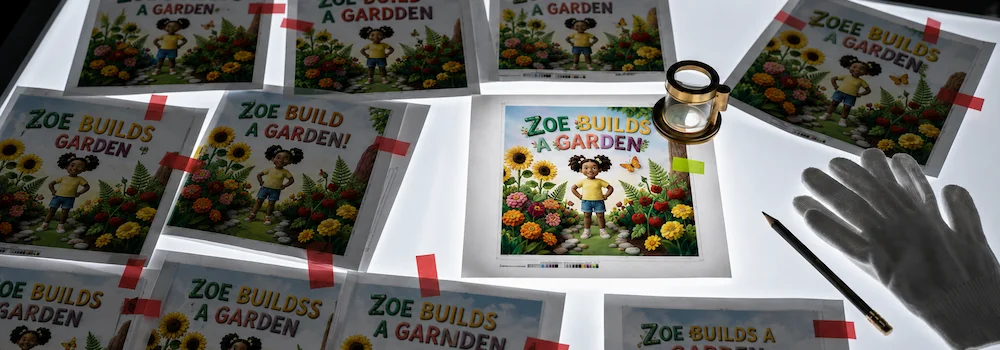
Every AI demo is built to answer one question: can the technology do something impressive? A prompt goes in, a story or an image comes out, the room reacts. Those moments are real and they matter. Our first experiments with personalized stories were exactly that kind of moment, and they're the reason Genie in a Book and Genie Comics exist.
But a demo enjoys advantages a product never gets. The person running it picks the input, knows what the system expects, and quietly throws away the failures until something great appears. The audience sees the one good result, never the six malformed ones behind it. A product faces strangers who upload whatever they have, read the instructions differently than you meant them, and notice details you never anticipated. Most conversations about responsible AI happen at the level of policy documents and principles. The version I've come to care about happens lower down, in review screens and recovery paths, because that's where customers actually encounter it.
A product doesn't get to choose its inputs
Picture demoing an AI-generated children's book. You pick a clear, well-lit photo, write a thoughtful description, generate a few times, and show the best one. The audience sees a recognizable child inside a storybook world, and the capability is proven.
Now open it to the public. One person uploads a professional family portrait; the next uploads a cropped screenshot from Instagram with someone's thumb in the corner. One photo has four kids in it and only one belongs in the book. One customer describes their story in nine words, another sends three pages of instructions with a plot twist in the middle. Some know exactly what they want, and some only know they want something special and expect the product to help them find it.
At that point the question stops being whether the model can generate a good image. It becomes whether the whole product can absorb the range of things real people do and still behave in a way that makes sense to them. What happens when the input is incomplete, when the output is technically fine but emotionally wrong, when the first attempt isn't good enough? Answering those isn't a distraction from building the AI product. Those answers are the product.
The model is plausible. The customer is specific.
Generative models produce plausible results, and plausible is usually enough for generic content. Personalization changes the standard. An image model can produce a convincing child in a garden, well composed, nicely lit, successful by every technical measure, and the customer will look at it and say that's not my daughter. They may not be able to articulate why. Parents recognize their kids through a thousand small signals no evaluation metric captures: the shape of a smile, something around the eyes, the way hair falls.
Stories fail the same way. A generated story can include the right people and follow the requested plot while completely misreading which relationship the book is about. Grandma gets two lines when she was the entire point. An inside joke gets taken literally and dies on the page. The model was given information. The customer was thinking about meaning. No amount of model improvement fully closes that gap, because the meaning was never in the prompt to begin with. A responsible product is one that's built knowing the gap is there.
The stakes rise when the content is someone's family
If a stock illustration has a weird hand, viewers notice and move on. Nothing was at stake; the picture wasn't of anyone. When the illustration was made from a customer's family photos, they're not evaluating artwork anymore. They're checking whether this is their kid, whether grandpa still looks like grandpa five pages later, whether the person missing from the campfire scene is the person the book was supposed to honor.
And the context is usually loaded. These books get made for birthdays, new siblings, graduations, and for relationships someone wanted to preserve on paper. A detail the system treats as decoration can be the emotional center of the order. One customer won't care that a shirt changed color between pages. Another will, because that shirt was from a real day. The system can't reliably tell which details are negotiable, so the product has to let the customer make that call instead of making it for them.
Regenerate is a feature, not a confession
There's a school of thought that says if users need a regenerate button, the AI isn't good enough yet. I think that gets creative work backwards. Writers rewrite. Illustrators sketch before they paint. Editors exist. Nobody has ever considered first-draft acceptance the standard for creative quality, and it's strange to impose that standard the moment a model is involved.
Generative systems are variable by nature. Even strong models misread prompts and drift on details, and a product that assumes every generation will land isn't optimistic, it's unfinished. So customers can page through their book before it prints, flag the illustrations that don't feel right, and ask for another take instead of accepting whatever came out first. Two generations can both be technically excellent while a parent instantly prefers one because it feels more like their kid. No scoring system replaces that judgment, and the customer shouldn't have to justify it. They just need a button that respects it.
For a physical product this review step is also plain risk management. A digital image can be swapped; a printed book is paper, ink, and a shipping deadline. The person who knows whether the child looks right should see the book before the printer does.
Human judgment isn't a patch waiting for a better model
A quiet assumption runs through the industry: human involvement is scaffolding, and it comes down once models improve. Sometimes true. Plenty of manual steps in our pipeline have already been automated away, and more will be.
But some judgment is human because the necessary information is human. The model knows the story includes a grandparent. It doesn't know the book exists to mark a relationship, or which small moment will be the one that makes the family laugh. That's not a capability gap that scales away; the model was never given that context, and often it can't be written down at all. Keeping a person in the loop there isn't an embarrassing compromise. It's the correct design, and it will still be the correct design three model generations from now.
Say what the product can't do
Trust erodes fastest when a product implies more certainty than the technology has. Customers don't need a lecture on transformer architectures, but they do deserve to know that generated content might need their review, which parts they control, and what happens when something's wrong. Marketing AI as effortless magic and then treating every flaw as a bizarre exception sells demos, and it burns customers exactly once.
We'd rather say all of it plainly. The system can produce original stories and illustrations at a price commissioned art never could. It can also misread an instruction, drift on a face, or nail the composition while missing the point. Both things are true at the same time, and a product built on that honesty ages better than one built on the highlight reel.
The same honesty applies inside the architecture. The model will eventually be wrong; the only question is what the product does next. Can the customer fix it without starting over? Can support see what happened? Does recovery cost the customer their work, or just a click? A disclaimer page repairs none of this. Reliability was never the absence of failure anyway. It's what the failure costs the person who hits it.
The demo is the beginning
The demo showed us that a child could become the recognizable hero of an original story, and that was enough to start a company on. Everything since has been the unglamorous remainder: designing for unpredictable input, building review and correction into the flow, planning for inconsistency, and leaving room for the judgment only customers can supply.
That remainder is where responsible AI actually lives. Not in the moment the output appears, but in everything the product is prepared to do after.