Parkside Labs
Personalized Books Existed Long Before AI. The Business Didn't.
Anyone with the budget could always commission a custom book for one child. AI is what made original stories and art cheap enough to sell as a product.

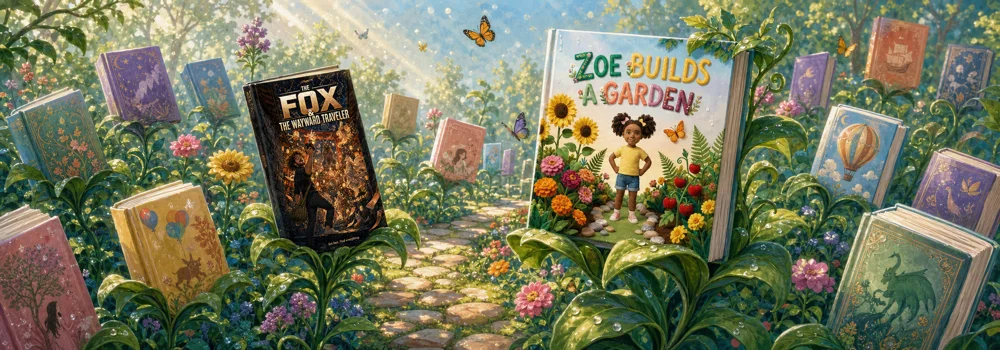
When someone asks what Genie in a Book is, I tell them we make books and comics where a child becomes the main character of an original story. Most people nod and picture the name-swap books they already know, where a fixed story gets your kid's name dropped into it. What we make works differently, and the difference only became affordable because of generative AI.
I want to be careful with that claim, because "AI made it possible" gets said about a lot of things it isn't true of. A custom book for one specific child has been possible for as long as you could hire a writer and an illustrator. If you have the budget, you could commission one tomorrow with no AI involved at all. Someone interviews the family, drafts a manuscript, revises it until everyone is happy. An illustrator studies photographs, does character studies, then paints twenty or thirty finished scenes. A designer lays out the pages and preps the files for print. That's weeks of work from several skilled people, and you'd be lucky to get out the door under a couple thousand dollars. Which is fair pay for the labor. It's also not something anyone buys as a birthday present for a four year old.
So the interesting question was never whether a truly custom book could exist. It was whether one could exist at a price a normal family would pay, ordered through a website, delivered in days rather than months.
The template compromise
The companies selling personalized books before AI solved the cost problem in a sensible way: do the creative work once, sell it thousands of times. The story is written in advance. The art is painted in advance. The customer supplies a name, picks a skin tone, maybe chooses a hairstyle from a short list, and the system slots those choices into a book that is otherwise identical for every buyer.
I have no quarrel with that model. The books can be lovely, and quality control is easy because every possible version of the book exists before anyone orders it. But the story can't know anything about the child beyond the blanks it was designed to fill. It can't include grandma. It can't put the family dog in chapter two. It can't make the kid a veterinarian because that's what she tells everyone at preschool she's going to be.
We wanted the customer to describe the adventure and have the book actually be about it. Once you allow that, every order is a different book with different scenes, different characters, and different emotional beats. A story about a boy building a treehouse with his dad shares almost nothing with a story about two sisters stranded on a space station. Those aren't variations on a template. They're separate books, and before generative AI, separate books meant separate creative teams.
What AI actually changed
People assume the answer is speed. Speed helps, but the change that matters is what each additional original book costs to make.
In a commission business, the hundredth custom book costs about as much as the first, because a human has to write and illustrate each one from scratch. Templates escape that by reusing nearly everything. Generative AI opened a third path: the story and the art can change with every single order, while the things that get reused are the software, the production rules, and the pipeline wrapped around the model.
An order still isn't free. We pay for generation, printing, payment processing, shipping, and support, plus the time it takes to review output and fix what's wrong. Some orders sail through. Others need images regenerated or a story reworked because the customer's idea was hard to translate. But the cost of originality no longer scales with human labor on every order, and that single change is what turns a bespoke service into a consumer product.
Comics multiply the difficulty
Genie Comics is the same idea in a much harder format. A picture book can give an illustration a whole page and let the text carry the plot. A comic tells its story through the pictures themselves. The same character appears panel after panel, running in one, reacting in the next, mid-sentence in the third, and the reader has to recognize them every time. Panels have to read in the right order. Dialogue has to fit the space the art leaves for it. An image can be beautiful on its own and still wreck the page it sits on.
Keeping a real child recognizable in one generated illustration is already a hard problem. Keeping her recognizable across ninety panels of action is where most of our engineering effort actually goes.
The generator is a small part of the product
A prompt wired to an image model gets you a demo. For a real order, software has to collect the photos and the story idea, figure out who belongs in the story and how they relate to each other, produce a narrative that fits the page count and reading level, generate art matched to specific moments, keep every character consistent, lay out pages for print, give the customer a way to review the result and ask for changes, take payment, produce files the printer will accept, and then follow the order through manufacturing and shipping.
And when generation misbehaves, the product has to recover, because it will misbehave. An extra child wanders into a scene. A face drifts between chapters. A panel fails to show the thing the script needed it to show. None of that is exotic. It's a normal week, and handling it gracefully is most of the job.
What the customer brings that the model can't
The model can write a story about a girl and her grandfather. It has no way of knowing the book exists because he's teaching her to fish the same way he taught her mother thirty years ago. It can paint the family dog into an illustration without knowing the dog is thirteen and this book is partly about him.
That knowledge belongs to the customer, and it's the whole reason the finished book is worth more than the paper it's printed on. Our job is to lower the wall between that private meaning and a physical object, so someone who can't draw and doesn't write can still make the thing they're picturing.
Customers never see any of the machinery, which is how it should be. What they see is a kid opening a book and finding herself inside it. AI is what made that moment affordable to sell. The family on the pages is what makes it worth buying.
If you're curious, the product is at genieinabook.com.